
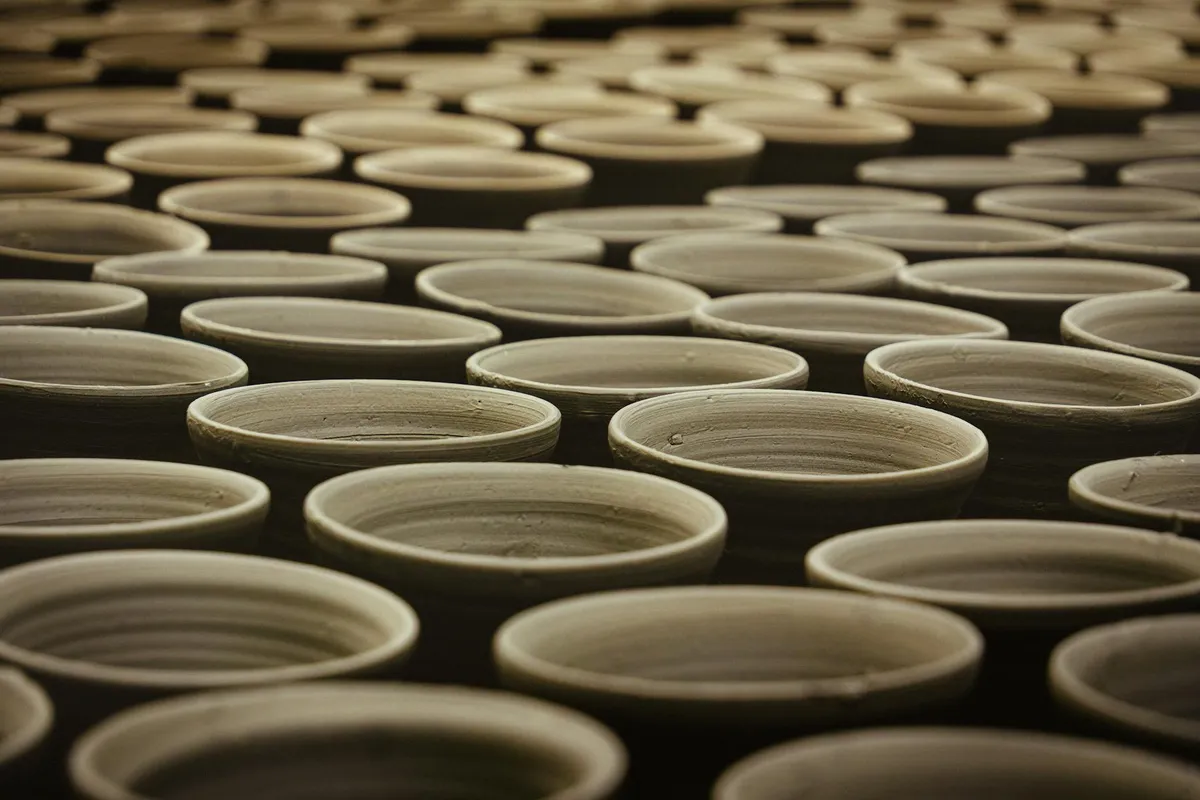
I have a tea bowl made by a contemporary Japanese potter in the Hagi tradition. It is not particularly large. The form is irregular but balanced. The glaze has a soft cream color with darker variations where the firing produced different chemistry. When I hold it, the weight is exactly what it should be — substantial enough to feel present, light enough not to fatigue the hand.
The potter who made it is the seventh generation in his family's pottery practice. His grandfather and father were both designated as Living National Treasures. He himself has been working at his craft for over fifty years. The bowl I hold cost roughly $400. It is also worth far more than that in any meaningful artistic accounting.
I want to think through what produces this kind of object, and why the tradition that produces it is worth understanding.
What Japanese pottery traditions actually are
Japanese pottery encompasses many distinct traditions, each with its own history, materials, techniques, and aesthetic principles. Some of the major traditions:
Hagi: Soft, porous, often pale-colored ware from Yamaguchi prefecture. Particularly valued for tea ware. The glazes develop and change with use over years.
Bizen: Unglazed ware from Okayama prefecture. Color and texture come from the firing process itself, with ash falling on pieces during long firings producing distinctive surface effects.
Shigaraki: Iron-rich ware from Shiga prefecture. Often features natural ash glaze effects and rough textural surfaces.
Karatsu: Kyushu pottery influenced by Korean traditions, often featuring decorated surfaces and varied glazes.
Mashiko: Folk pottery tradition from Tochigi prefecture, popularized by Shoji Hamada in the 20th century.
Each tradition has specific clays, firing techniques, glaze chemistries, and forms that have been refined over generations of practitioners. The differences are not arbitrary; they reflect specific local materials and specific aesthetic histories.
What multi-generational craft transmission actually involves
Japanese pottery traditions are mostly transmitted through family lineages. A potter's child grows up in the workshop, internalizing techniques through observation and gradual participation from childhood. By the time they take over the practice in their thirties or forties, they have absorbed knowledge that cannot be transmitted through formal instruction.
This kind of knowledge transmission produces specific kinds of expertise:
Embodied technique. The way the hands move on the wheel, the precise pressure on the clay, the timing of various operations. These are learned through years of physical practice rather than through verbal instruction.
Material knowledge. The specific characteristics of the clay used by a particular family pottery, how it responds to different working techniques, how it behaves in different firings. This knowledge accumulates over generations.
Aesthetic judgment. The ability to recognize when a piece is succeeding versus when it is not. This judgment is calibrated through observing thousands of pieces over years of training.
Process discipline. The systematic approach to all aspects of pottery making, from clay preparation through firing. The specific ways things are done that have been refined through generations.
This kind of cumulative craft knowledge cannot be replicated by individuals working without the lineage. It is the result of generations of work refined and transmitted.
The relationship between tradition and individual practitioner
One of the interesting aspects of Japanese craft traditions is the relationship between inherited tradition and individual creativity. The tradition provides the framework — specific techniques, materials, forms, aesthetic principles. The individual practitioner works within that framework but with personal expression.
The seventh-generation Hagi potter who made my tea bowl is making something that recognizably belongs to the Hagi tradition. The form and glaze and approach are continuous with what his ancestors made. But the specific bowl is also distinctly his — his individual choices within the tradition.
This relationship is different from much Western craft, where individual expression often takes precedence over tradition. The Japanese model treats tradition as the substantial value being transmitted, with individual contribution as variation within that framework rather than departure from it.
Both models can produce excellent work. They produce different kinds of excellence.
What the cost actually represents
The $400 tea bowl reflects several things that conventional pricing does not always capture:
The years of training behind it. The potter who made it spent decades developing the capability to make it. The cost partially reflects amortization of that training time.
The cumulative knowledge of the tradition. The bowl benefits from seven generations of family craft knowledge. The cost partially reflects the value of that accumulated capability.
The materials and process. Quality clay, multiple firings, careful handling at every stage. These have real costs.
The selection and rejection. Many pieces are made for every piece that is offered for sale. The cost includes the pieces that did not meet the standard.
The cultural and aesthetic value. The bowl is a particular kind of cultural artifact whose value extends beyond its functional or material cost.
By contrast, the mass-produced Japanese-style tea bowl that costs $20 reflects materials and labor cost only. It does not embed the cumulative craft knowledge that makes the authentic bowl what it is.
The contemporary challenges
Multi-generational Japanese craft traditions face substantial contemporary challenges. Several pressures:
Demographic decline. Children of craftspeople increasingly choose other careers. Many family workshops have no one to inherit them.
Material costs. Some traditional materials are becoming scarce or expensive. Some clays from specific traditional sites are essentially exhausted.
Market pressure. Mass-produced alternatives at lower prices have shrunk the market for authentic craft work. The audience of buyers who can distinguish and pay for authentic work is smaller than it was.
Cultural shift. Daily Japanese life has shifted away from many of the contexts in which traditional craft objects were used. Tea ceremony participation, traditional dining patterns, traditional household practices have all declined.
These pressures threaten the continuation of multiple traditions. Several have already collapsed; many others are at risk.
What can be done
For people who care about supporting the continuation of these traditions, several practices help:
Buy authentic work from current practitioners. Direct economic support of working craftspeople is the most direct support available.
Visit kiln sites and exhibitions when possible. Tourism that engages substantively with craft traditions provides income beyond direct purchases.
Educate yourself about distinctions. The ability to distinguish between authentic work and mass-produced alternatives matters for the market dynamics that affect craftspeople's livelihoods.
Support organizations preserving traditional knowledge. Various Japanese cultural institutions work to document and preserve craft traditions.
None of these practices alone will sustain traditions. Together they contribute to the conditions in which traditions continue.
What this teaches
The Japanese craft tradition demonstrates a particular pattern of cultural production that is increasingly rare globally: the multi-generational transmission of embodied knowledge, refined over centuries, sustained through family lineages and apprenticeship.
Most contemporary craft works on different patterns — individual artists trained through formal education, working in styles they have developed personally, often without strong connection to specific historical traditions. This produces excellent work but different from what the lineage tradition produces.
Both patterns have value. The lineage tradition is more vulnerable. The pieces that emerge from it are not replicable through other patterns.
A closing observation
The tea bowl on my shelf represents seven generations of accumulated craft knowledge embodied in one practitioner's recent work. It will continue to develop with use over years — Hagi glazes are known to change over decades of being used for tea.
I am one user of this bowl among many. The bowl will outlast my use of it. The tradition that produced it has, with luck, more generations of work ahead.
This kind of long-horizon cultural production is increasingly rare in the contemporary world. The tea bowl is, in some quiet way, a small piece of what is increasingly hard to produce. The continuation of the tradition is not automatic; it depends on choices being made now by potters, by buyers, by cultural institutions.
The bowl holds the tea. The tradition continues, for now, because individual people decide it should continue.